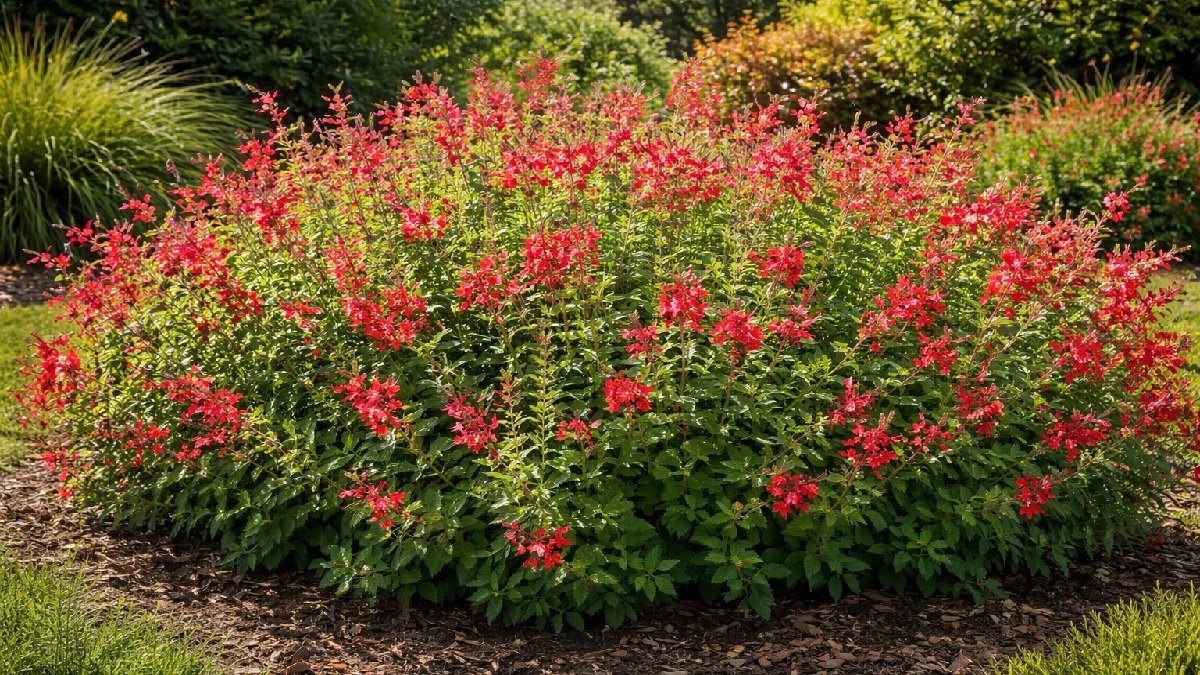
Autumn Sage is considered a low-maintenance shrub that rewards gardeners with long-lasting blooms and healthy foliage when provided with suitable growing conditions. Once established, the plant requires relatively little attention and can thrive even in dry or nutrient-poor soil environments. Planting it in a location that receives plenty of sunlight and has well-drained soil is the most important factor for successful growth. Regular observation during the growing season helps ensure the plant remains healthy and productive, allowing gardeners to remove any damaged stems or faded flowers that might hinder new growth.
Occasional pruning throughout the year helps maintain the plant’s compact, rounded shape and encourages the development of fresh flowering stems. Removing spent blooms, a practice commonly known as deadheading, can stimulate additional flower production and prolong the blooming season. Applying a layer of organic mulch around the base of the plant can also help retain soil moisture, suppress weeds, and moderate soil temperature. With these simple care practices, Autumn Sage remains an attractive, resilient plant that continues to provide color and pollinator activity in the garden for many months each year.
Autumn Sage thrives best in locations that receive full sunlight for most of the day. Ideally, the plant should receive at least six to eight hours of direct sunlight daily to encourage strong growth, abundant flowering, and vibrant flower coloration. In sunny garden beds or open landscapes, the plant develops sturdy stems and dense foliage that support its continuous production of colorful blossoms throughout the growing season.
While full sun is preferred, Autumn Sage can tolerate light partial shade, especially in regions with extremely hot summers. However, too much shade may reduce flower production and cause the plant to grow more sparsely. When selecting a planting location, areas with good air circulation and ample sunlight provide the most favorable conditions. Proper light exposure not only enhances the plant’s ornamental value but also supports its natural drought tolerance and resilience in warm climates.
Autumn Sage grows best in well-drained soil that allows excess water to pass through easily, preventing moisture from accumulating around the roots. Sandy or loamy garden soil is ideal because it provides adequate aeration while still retaining enough nutrients to support healthy plant development. In natural habitats, the plant often grows in rocky or gravelly soil, which explains its excellent tolerance for soils that may be considered poor for many other ornamental plants.
Although the plant adapts to a wide range of soil conditions, maintaining good drainage is essential to avoid root rot or fungal problems. If garden soil is heavy clay, it can be improved by incorporating coarse sand, compost, or small gravel to enhance drainage and soil structure. Autumn Sage also tolerates slightly alkaline soil conditions, making it suitable for many dry or arid landscapes. Improving the soil with organic matter occasionally helps maintain fertility and supports vigorous growth and flowering.
During the first growing season after planting, Autumn Sage benefits from consistent watering to help establish a strong and extensive root system. Deep watering once or twice per week, depending on weather conditions and soil type, allows moisture to reach the deeper root zones and encourages the plant to develop drought resistance over time. It is important to allow the soil surface to dry slightly between watering sessions to prevent excessive moisture accumulation.
Once established, Autumn Sage becomes highly drought tolerant and requires far less frequent watering than many other garden plants. In most climates, occasional watering during extended dry periods is sufficient to keep the plant healthy and productive. Overwatering should be avoided because it may lead to weak growth or root problems. Applying mulch around the base of the plant can help retain moisture, reduce evaporation, and keep the root zone cool during hot summer months.
Autumn Sage performs exceptionally well in warm climates and is naturally adapted to withstand high temperatures and relatively dry air. The plant thrives in USDA hardiness zones 7 through 10, where it experiences long growing seasons and abundant sunshine. Its natural resilience allows it to tolerate heat waves and dry conditions that might stress many other flowering plants.
Although the plant prefers warm weather, it can also tolerate brief periods of cooler temperatures once it becomes established. In regions with mild winters, Autumn Sage may remain evergreen or semi-evergreen, continuing to provide ornamental interest throughout the year. Adequate air circulation and good drainage further help the plant remain healthy in humid climates by preventing fungal diseases. These environmental tolerances make Autumn Sage a dependable choice for gardens located in warm and semi-arid regions.
Autumn Sage generally requires minimal fertilization because it naturally thrives in soils that are not particularly rich in nutrients. In fact, excessive fertilization can sometimes encourage lush leafy growth at the expense of flower production. For most gardens, incorporating organic compost into the soil during spring planting provides sufficient nutrients to support healthy development throughout the growing season.
If additional feeding is desired, a light application of a balanced slow-release fertilizer in early spring can encourage steady growth and flowering. Gardeners should avoid heavy feeding or high-nitrogen fertilizers, as these may reduce the plant’s drought tolerance and cause overly soft growth. By maintaining moderate soil fertility and avoiding excessive fertilization, Autumn Sage continues to produce abundant blooms while retaining its naturally compact growth habit.
Regular pruning helps keep Autumn Sage looking neat, compact, and productive throughout the growing season. Light trimming in early spring encourages the plant to develop strong new shoots that will produce flowers later in the season. Gardeners often remove any winter-damaged or weak stems at this time to improve the plant’s overall structure and appearance.
Deadheading spent flowers throughout the season can encourage the plant to produce additional blooms, extending the flowering period well into fall. In mid to late summer, light shaping may also be performed to maintain the plant’s rounded form and prevent it from becoming too woody or leggy. Pruning not only enhances the plant’s visual appeal but also improves air circulation within the foliage, helping to reduce the risk of pests or disease.
Autumn Sage can be propagated through several methods, allowing gardeners to expand their plant collection or share plants with others. One of the most common techniques is propagation through softwood cuttings taken during the active growing season. Healthy stems can be cut just below a leaf node and planted in moist, well-drained soil or rooting medium, where they will gradually develop new roots over several weeks.
The plant can also be propagated by division or by collecting seeds from mature flower heads. Division works well for older plants that have developed multiple stems, allowing gardeners to carefully separate sections and replant them in suitable locations. Seed propagation may require more time and patience but can produce many new plants. Regardless of the method used, providing warm temperatures, adequate moisture, and good soil drainage helps ensure successful establishment of newly propagated plants.