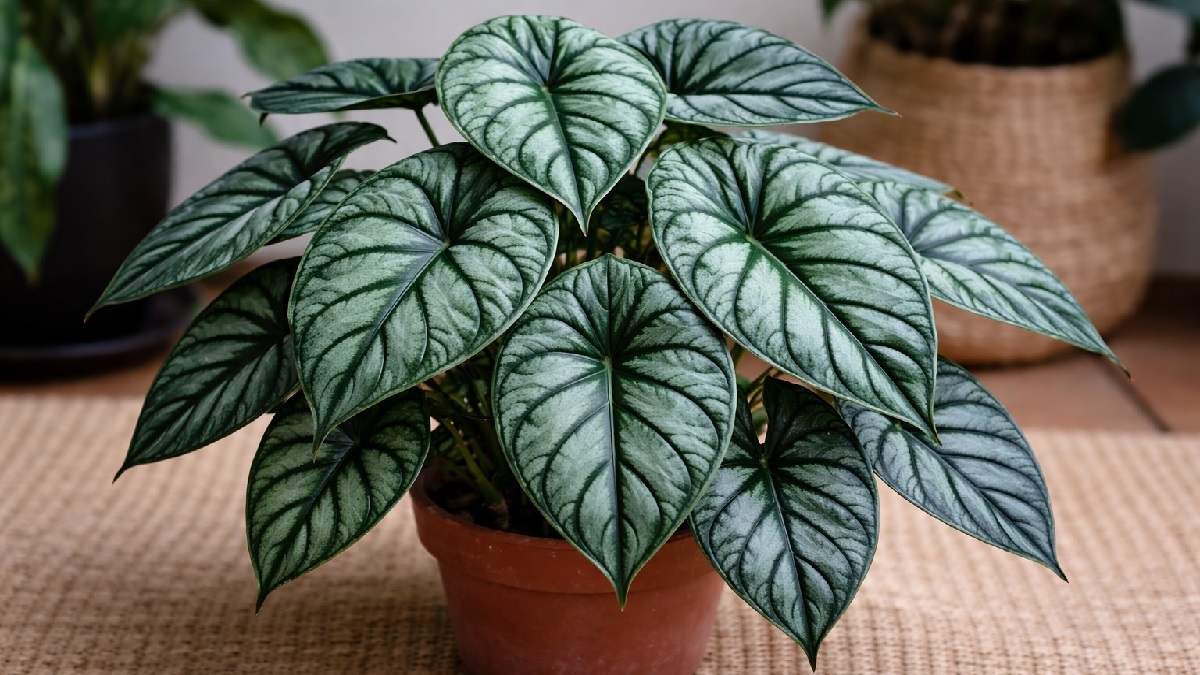
Alocasia "Dragon Scale" gives interior rooms a tropical touch but requires careful maintenance. High humidity is ideal for the plant, which requires steady hydration without becoming soggy. To preserve the vivid "dragon scale" patterns, keep the leaves from turning yellow by using a potting mix that drains well and keeping them out of direct sunshine. Alocasia "Dragon Scale" health depends on careful monitoring of these circumstances.
Bright, indirect sunlight is ideal for Alocasia "Dragon Scale." While too little light might result in lanky growth, too much sunlight may burn its leaves. Put it in a room with plenty of natural light or close to a window with sheer curtains to filter the light.
A thick, well-draining potting mix is necessary for dragon scale alocasias. It is best to use a soilless mixture of equal amounts of coco coir, perlite, and orchid bark, but you may also use sandy potting soil in place of the coco coir. The plant is more susceptible to root rot in a thick media, therefore avoid using plain potting soil.
Maintain a constant level of moisture in the soil without making it soggy. When the top one to two inches of soil feel completely dry to the touch, water it. Make sure your pot has enough drainage because overwatering might cause root rot.
Dragon scale alocasia, like the majority of alocasias, prefers high humidity levels (60% to 80%). It thrives in small greenhouses or terrariums, as well as when a tiny humidifier is positioned close by. They thrive in normal indoor temperatures between 55 and 80°F. Be mindful that a plant may go into dormancy if it is exposed to low temperatures on a regular basis.
During the growth season, use a balanced liquid fertilizer that has been diluted to half strength every four to six weeks. When growth slows down in the winter, avoid fertilizing.
Pruning is beneficial for maintaining the vitality and beauty of Alocasia "Dragon Scale," which is well-known for its eye-catching leaves. Early in the spring, when new growth is starting, prune Alocasia "Dragon Scale." To promote fuller development, trim back any lanky or overgrown stems and remove any dead or damaged leaves. Pruning encourages healthy growth and aids with disease prevention. To prevent infections, make sure sterile instruments are utilized. This technique preserves the plant's appealing look while promoting ideal plant health.
Like many Alocasia species, Alocasia "Dragon Scale" is best propagated via division. In order to produce new plants, the plant's rhizomes, or subterranean stems, must be separated. Alocasia "Dragon Scale" is best propagated in the spring or early summer, when the plant is starting to develop actively. As a result, the divisions have a greater opportunity to establish themselves prior to the winter months. To make sure the soil is wet and the plant is hydrated, water the plant the day before you intend to divide it. Take care not to harm the roots when you carefully remove the Alocasia "Dragon Scale" from its container. Dig gently around the plant to remove it from the ground if it is grown outside. To make the rhizome and root structure visible, carefully remove as much dirt as you can from the area surrounding the roots. In the rhizome, look for natural divisions. There should be some roots and a minimum of one growth point (node) every division. Cut the rhizome into parts with a clean, sharp knife or shears, ensuring sure that each segment has a portion of the roots and at least one growing point. Each division should be planted in a separate container using potting mix that drains effectively. In order to avoid too much moisture around the roots, the pot should be the right size for the division. To settle the dirt around the roots, softly water the recently planted divisions. Put them in an area that will get plenty of indirect light. Use a humidifier or set the pots on a tray of pebbles and water to raise the ambient moisture levels around the plants. Maintain a constant level of moisture in the soil without making it soggy. To encourage the growth of the young plants, keep the humidity high. Steer clear of direct sunlight to avoid burning your leaves.
Growing Alocasia "Dragon Scale" from seed is feasible but difficult because they rarely produce viable seeds; propagation from corms or pups (offsets) is more prevalent and dependable; for successful establishment, these underground parts must be separated and planted in moist, well-draining soil with high humidity as well as bright, indirect light. If you have seeds, you must properly clean them, plant them shallowly, and keep them constantly wet and warm.
Alocasia dragon scale should be repotted every two to three years or once roots start emerging from the bottom of the pot. It doesn't mind being little root bound. When these plants are no longer dormant and are actively developing, it is ideal to repot them between mid-spring and early summer. Refresh as much of the potting media as you can without harming the plant's roots in a container that is one to two inches bigger than the previous one. To assist your dragon scale settle into its new pot, give it plenty of water after repotting.
In order to manage an Alocasia "Dragon Scale's" natural dormancy over the winter, you should try to offer strong, indirect light, cut back on watering, and cease fertilizing. Preventing root rot and keeping it warm are crucial.
To promote your Alocasia 'Dragon Scale' to bloom, which it rarely achieves indoors, mimic its tropical habitat by providing bright, indirect light, high humidity (60-80%), constantly wet but not soggy chunky soil, warm temperatures (65-75°F/18-24°C), and regular feeding with balanced fertilizer during growth, while avoiding direct sunlight and cold drafts. Blooming signals mature health, but the little white flowers are less important than the gorgeous leaves, so maintain optimal conditions to enhance overall plant vitality and leaf output.
Common houseplant pests such as fungus gnats, scale, spider mites, and thrips can all cause problems for dragon scale alocasia. Inspect your plant for pests on a regular basis and apply a pesticide as soon as an infestation is detected. It is also prone to root rot, which is mainly caused by poor watering and/or drainage. Under the correct circumstances, these lovely plants flourish inside, but if their requirements are not satisfied, you may encounter some of the following typical issues. If your dragon scale alocasia is loosing leaves, it is most likely because it does not get enough light, water, or humidity. Examine your plant's growth circumstances to see what could be lacking. Alocasias often go into hibernation throughout the fall and winter months, dropping all of their leaves. This does not usually occur inside, but it is conceivable. If your plant is dormant, don't worry. Simply cut back on watering & wait it out. In the early spring, you should start to observe fresh growth. Yellow leaves on a dragon scale alocasia usually indicate that your plant is being overwatered. It can sometimes indicate root rot. Reduce watering to avoid more leaves from yellowing, and consider inspecting your plant's roots to detect any early indications of root rot. Curling leaves of dragon scale alocasia are generally indicative of a lack of moisture and humidity. Make cautious not to submerge your plant, and if feasible, increase the humidity surrounding it.