Germination: The Beginning of Plant Life
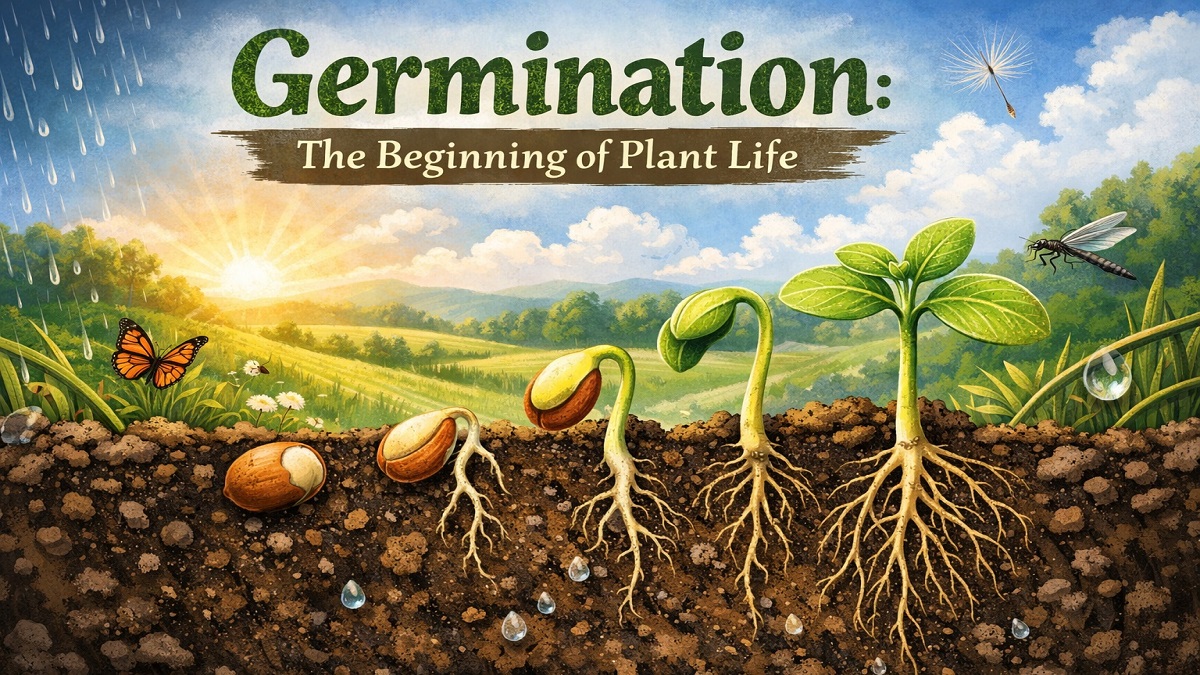
Germination is the process by which a seed develops into a new plant. It is one of the most important stages in the life cycle of plants, marking the transition from a dormant seed to an actively growing organism. Without germination, plant reproduction and food production would not be possible. Every tree, crop, flower, and grass begins its life through this fundamental biological process.
Germination is influenced by environmental factors such as water, temperature, oxygen, and sometimes light. When conditions are favorable, the seed “wakes up” from dormancy and starts to grow.
What Is Germination?
Germination is defined as the growth of a seed into a seedling under suitable conditions. A seed contains three main parts:
- Embryo – the tiny, undeveloped plant inside the seed.
- Endosperm (or cotyledons) – the stored food that nourishes the embryo.
- Seed coat – the protective outer covering.
When a seed absorbs water, the seed coat softens and breaks. The first visible sign of germination is the emergence of the radicle (young root), followed by the plumule (shoot).
Importance of Germination
Germination ensures the continuation of plant species and supports the entire food chain. Plants produce food through photosynthesis, supporting herbivores and indirectly carnivores and omnivores.
For humans, germination is vital for agriculture. Crops such as rice, wheat, maize, vegetables, and fruits all begin with germination.
Stages of Germination
1. Imbibition
The seed absorbs water, swells, and activates growth enzymes.
2. Activation of Enzymes
Stored food is converted into simpler substances for energy.
3. Growth of Radicle
The embryonic root emerges first and grows downward.
4. Growth of Plumule
The shoot grows upward to form stem and leaves.
5. Seedling Establishment
The plant develops true leaves and begins photosynthesis.
Conditions Required for Germination
- Water – Activates enzymes and softens the seed coat.
- Oxygen – Needed for respiration.
- Temperature – Each species has an optimum range.
- Light (for some seeds) – Some require light, others darkness.
- Soil or Growing Medium – Provides nutrients and support.
Types of Germination
1. Epigeal Germination
Cotyledons emerge above the soil surface. Example: beans and sunflower.
2. Hypogeal Germination
Cotyledons remain below the soil. Example: peas and maize.
Seed Dormancy and Germination
Some seeds enter dormancy, a temporary suspension of growth. Dormancy can be broken by:
- Scarification
- Stratification
- Light exposure
- Chemical treatment
Germination in Agriculture
Farmers promote successful germination using quality seeds, proper irrigation, and soil preparation.
Seed Treatment
Seeds are treated to prevent disease and improve growth.
Nursery Germination
Crops are often started in nurseries before transplantation.
Greenhouse and Controlled Germination
Greenhouses provide controlled temperature, humidity, and light.
Factors Affecting Germination
- Seed Quality
- Soil Moisture
- Soil Temperature
- Depth of Sowing
- Salinity and pH
Germination and Climate Change
Climate change affects germination through rising temperatures, irregular rainfall, droughts, and floods. Scientists are developing climate-resilient seeds to improve future food security.
Germination in Natural Ecosystems
Germination supports forest regeneration and biodiversity conservation. Some seeds require fire or animal digestion to break dormancy.
Human Uses of Germination
Sprouting
Sprouted seeds are nutrient-rich and easier to digest.
Malting
Barley seeds are germinated to produce malt for beverages.
Research and Education
Germination experiments help teach plant biology and life cycles.
Common Problems in Germination
- Seed rot due to overwatering
- Poor soil drainage
- Low temperature
- Old or infertile seeds
- Pest and fungal attacks
Conclusion
Germination is the foundation of plant life and a critical process for ecosystems, agriculture, and human survival. Understanding germination helps improve crop yields, biodiversity conservation, and food security in a changing world.
Frequently Asked Questions
What is germination?
Germination is the process by which a seed develops into a seedling under favorable environmental conditions such as water, oxygen, and suitable temperature.
What are the main stages of germination?
The stages include imbibition (water absorption), enzyme activation, radicle growth, plumule growth, and seedling establishment.
What conditions are required for germination?
Seeds generally require water, oxygen, proper temperature, and sometimes light. Soil quality and depth of sowing also influence successful germination.
What is the difference between epigeal and hypogeal germination?
In epigeal germination, cotyledons emerge above the soil surface. In hypogeal germination, cotyledons remain below the soil surface while only the plumule grows upward.
Why do some seeds remain dormant?
Seed dormancy prevents germination during unfavorable environmental conditions such as extreme cold or drought. It ensures that seeds sprout only when survival chances are high.